
The conversation around AI in marketing has focused on one central question: how can companies use artificial intelligence to target, personalise and convert more effectively? That question matters. But it may not be the most important one.
The deeper shift could come from the other side of the equation: not from companies using AI to better understand consumers, but from consumers using AI to better protect themselves from companies. This is a fundamental reversal of power.
For decades, brands have invested in tools designed to get closer to the customer: more data, more segmentation, more automation, more retargeting, more content, more personalisation. The underlying logic was clear — the more a company knows about a customer, the better it can influence their decision.
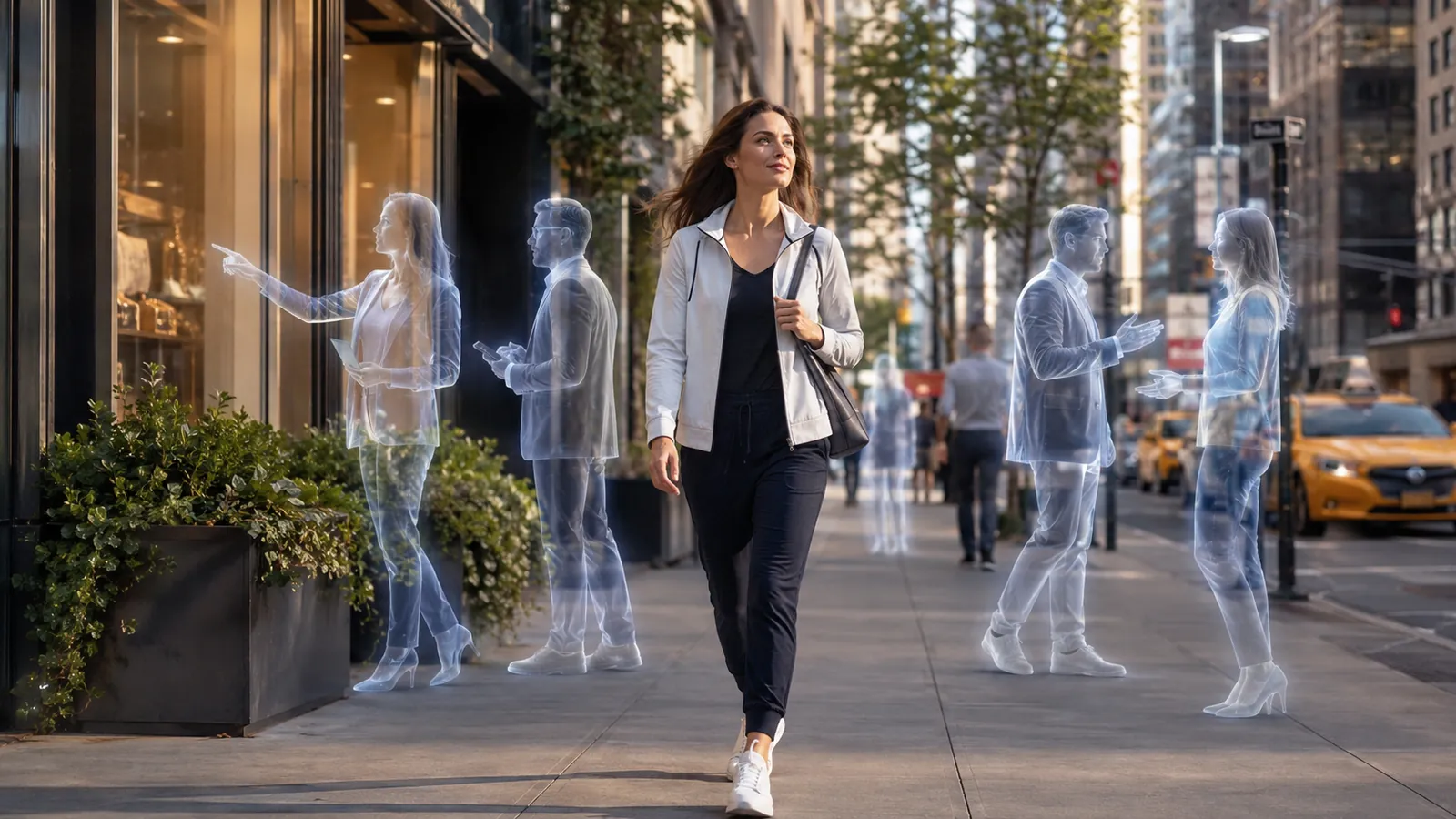
But tomorrow, the customer may no longer be alone in front of the market. They may be surrounded by their own group of Virtual Life Advisors — AI agents acting as digital guardian angels to filter noise, challenge decisions, simulate consequences and protect their long-term interests. This could change marketing, product design and business models more deeply than any media channel, CRM tool or content platform.
The consumer is no longer just overwhelmed. They are becoming protected.
Modern consumers are exposed to an almost permanent stream of commercial pressure: too many emails, too many ads, too many notifications, too many offers, too many recommendations, too many claims and too many choices. Marketing has become incredibly efficient at capturing attention — but it has also contributed to exhausting it. The result is not only marketing fatigue. It is cognitive fatigue.
Consumers do not only need better recommendations. They need protection from bad decisions, irrelevant offers, manipulative urgency and unnecessary complexity. This is where AI agents may become transformative. The next generation of personal agents may not simply help people shop faster; they may act as a protective layer between the individual and the market — filtering what deserves attention, identifying what is irrelevant, comparing alternatives, challenging impulse decisions and asking whether an offer is truly aligned with the person's goals.
In that sense, AI agents may become something more human than the word "agent" suggests. They may become digital guardian angels.
The rise of Virtual Life Advisors
The most powerful version of this future is not a single shopping assistant. It is a personal group of AI advisors supporting the individual across the different dimensions of life. One advisor may evaluate financial consequences. Another may assess health implications. Another may look at time, family, career, emotional state, legal risk or personal values.
Together, these advisors would not simply answer "What should I buy?" They would help answer a much deeper question: "What decision is most likely to help me become the person I want to be?" This changes the role of the market. The customer is no longer a passive target exposed to messages; they become an augmented decision-maker, surrounded by a system designed to protect their attention, their interests and their future trajectory. For companies, this means that the old logic of persuasion will no longer be enough.
From B2C to B2A: Business to Agent
We know B2C. We know B2B. We know D2C. The next frontier may be B2A: Business to Agent. In a B2A world, the customer remains human, but the first layer of evaluation may be machine-based. The company will still need to inspire the person, create desire and build emotional connection. But it will also need to convince the customer's AI agents that its offer is relevant, credible, timely and aligned with the user's long-term interest.
This is a very different competitive environment. An agent will not be impressed by vague storytelling, artificial urgency or emotional pressure. It will evaluate the offer through a different lens: Is this solution really useful now? Are the claims verifiable? Is the price justified? What are the alternatives? What is the risk of regret? Has this company delivered on its promises before? Does this decision support the customer's future goals?
Marketing is no longer only about visibility. It becomes about admissibility.
The key question is no longer only "How do we capture the customer's attention?" It becomes "How do we become admissible in the customer's decision system?" That is a profound shift.
From personalisation to trajectory
Most personalisation today is still based on the past or the present. You bought this, so you may like that. You searched for this, so here is an offer. You belong to this segment, so here is a message. But the next level may not be personalisation. It may be trajectory.
The question becomes: Who is this person today? Who do they want to become? What is preventing them from getting there? Which product, service or decision could increase their probability of reaching that future state? This is not simply about adapting a product to a preference. It is about designing an offer around a desired life outcome. The company no longer starts with "Here is the product we want to sell." It starts with "Here is the transformation the customer is trying to achieve." That changes product design, marketing, customer experience and operating models.
The reversal of product and service creation
For most of modern business history, companies have created products first and then tried to make customers adopt them. The logic was linear: we design the product, we define the positioning, we launch the campaign, the customer adopts — or not. Even customer-centricity often remained product-centric. Companies listened, ran research, built personas, tested concepts and improved experiences — but the starting point was still usually the company's offer.
In an agent-mediated world, this logic may be reversed. The starting point will no longer be "What product can we sell to this customer?" It will become "What solution should exist for this person, at this moment, given who they are and who they want to become?"
If the customer's AI agents understand their goals, constraints, context, preferences, risks and desired future, they may not simply evaluate existing products. They may also define what the ideal product or service should look like. The agent could say: "Given my user's financial situation, health goals, family constraints, time availability and long-term ambition, this is the type of solution they need now." Demand may become more explicit, more contextual and more precise before the company even proposes an offer.
Product creation would then move from a company-led process to a more adaptive, demand-led and outcome-led process. The company's role changes from "Convince the customer to adapt to our product" to "Build the product or service that best adapts to the customer's trajectory." Products may become more modular, configurable and dynamic — assembled around a specific life context rather than sold as fixed packages. The best companies will not only have strong products; they will have the capability to recompose their products and services around individual trajectories.
The product becomes a Life Outcome Enabler
Once product creation is reversed, the product itself changes nature. It is no longer something the customer must adopt and integrate into their life. It becomes a solution designed around the customer's life trajectory. A product is no longer just a product; it becomes a Life Outcome Enabler — a lever that increases the probability of helping the customer reach a desired future state.
A bank does not simply sell a financial product; it helps increase the probability of financial security. A health company does not simply sell a programme; it helps increase the probability of better energy, longevity or prevention. An education company does not simply sell a course; it helps increase the probability of career progression. A mobility company does not simply sell transport; it helps increase the probability of freedom, efficiency or access. The product becomes a lever in the customer's life trajectory.
This is where the idea of Life Maximisation becomes important. The strongest companies of the future may not simply say "Here is the product you will like." They may be able to say: "Here is who you are today. Here is who you want to become. Here is what we can offer now to maximise your chances of getting there." The company no longer sells only a feature, a service or an experience. It sells an increased probability of helping the customer reach a future version of themselves. That is a much more ambitious definition of value.
From Product-Market Fit to Person-Future Fit
For years, one of the most important concepts in business has been Product-Market Fit. Does the product fit the market? Is there demand? Can it scale? Does the value proposition resonate? But in a world where AI agents understand the customer's life context, goals, constraints and desired future, another concept may emerge: Person-Future Fit.
The question is no longer only whether a product fits a market. It becomes whether a solution fits the future self the customer is trying to build. This is a deeper and more demanding standard. A product may be attractive, well-positioned and well-marketed, but still fail the Person-Future Fit test if it does not help the customer progress toward the life they actually want. In that world, relevance is not defined only by preference. It is defined by trajectory.
The new accountability: when broken promises become data
This shift also creates a new form of accountability. Today, if a customer is disappointed, they may leave a bad review, stop buying or tell a few people. But in a B2A world, the consequence could be much more structural. The customer's AI agent will remember. It will compare the promise made with the outcome delivered. It will observe whether the product actually helped, whether the service created progress, whether the decision produced satisfaction or regret.
If the gap between promise and outcome is too large, the company may not only lose trust. It may become non-recommendable. The agent could downgrade the brand, exclude it from future recommendations or even blacklist it entirely.
Disappointment becomes data. Broken promises become memory. Overpromising becomes a long-term liability.
A company will no longer be judged only on how well it sells. It will be judged on whether the life impact it promised actually materialised. Trust will no longer be built only through communication, image or emotional affinity — it will increasingly be calculated through the accumulated memory of outcomes delivered versus outcomes promised. In the B2A era, the most dangerous thing for a brand may not be being ignored. It may be being blacklisted by the customer's guardian angels.
What this means for companies
To succeed in this environment, companies will need to rethink their operating model. They will need to move from campaigns to decision journeys, from persuasion to proof, from product features to life outcomes, from CRM pressure to useful anticipation, from storytelling to evidence, from conversion metrics to outcome accountability.
Several capabilities will become critical. First, Need Intelligence: the ability to understand not only current demand, but emerging life needs, transitions and moments of decision. Second, Agent Readiness: offers must become readable, comparable and verifiable by AI agents — pricing, claims, availability, conditions, guarantees and proof points structured and transparent. Third, a strong Trust and Proof Architecture: brands will have to support their promises with evidence, not only emotion. Fourth, Outcome Accountability: if the company claims to help the customer achieve a result, it must measure whether that result was actually achieved. Fifth, Product and Service Adaptability: if customer agents begin defining more precise needs, companies will need to configure, bundle or redesign solutions around individual trajectories rather than forcing people into fixed offers. And finally, an ethical framework: if companies can anticipate needs, they must also decide what they refuse to exploit. Vulnerability, urgency, stress or fear should not become commercial opportunities disguised as relevance.
Operational implication
What this shift means for retail, luxury and consumer brands
Agent readiness is not only a marketing challenge.
It affects product data, content, commerce, clienteling, merchandising, customer service, operations and governance.
Explore how these changes translate into AI-native capabilities, workflows and operating models for retail, luxury and consumer brands.
Explore AI transformation for retail, luxury and consumer brandsConclusion: from selling products to enabling better lives
The future of marketing may not be only about AI-generated content, predictive targeting or personalised recommendations. The deeper shift may be this: the consumer will no longer be an isolated target. They will become an augmented individual, supported by their own group of Virtual Life Advisors and digital guardian angels.
The company will no longer compete only for attention; it will compete for admissibility in the customer's decision system. Product and service creation will no longer start only with what the company wants to sell; it will increasingly start with who the customer is, who they want to become and what solution should exist to help them get there. The product will no longer be judged only by its features, but by its impact on the customer's desired future.
This is the move from B2C to B2A. From Product-Market Fit to Person-Future Fit. From selling products to becoming a Life Outcome Enabler. From marketing promises to Life Maximisation. From customer adoption to customer trajectory. The companies that win in this new world may be those that can prove, to both the human and their agents, that they genuinely increase the probability of a better life.