
For a while, the story was satisfyingly simple. Artificial intelligence needed GPUs. Nvidia had the GPUs. Therefore Nvidia owned the future.
As market narratives go, it had the virtue of being easy to understand — and, for investors, highly profitable. It was not exactly wrong. But it was incomplete in the way many successful narratives are: it mistook the most visible constraint for the only one.
The latest results from AMD, Intel and SanDisk suggest that the AI economy is broadening beyond its first bottleneck. GPUs remain central. But the infrastructure required to run artificial intelligence at scale is beginning to pull on the rest of the hardware stack: CPUs, memory, storage, networking, data centres, power and supply chains.
The boom is no longer just about making models smarter. It is about making enough physical capacity available for them to be used.
From training to use
The first phase of the AI race was dominated by training. That was a world of large models, giant GPU clusters and spectacular capital expenditure. In that world, the obsession with Nvidia was rational. The company sat at the narrowest point of the funnel.
But the economics of AI change as models move from laboratories into products.
Training is episodic. Inference is continuous. A model may be trained in a concentrated burst of computation, but once deployed it must respond to millions — eventually billions — of requests. Each query triggers a chain of activity: data retrieval, memory access, storage reads, networking, orchestration, ranking, tool calls and, increasingly, agentic workflows that unfold over several steps.
The result is that AI begins to look less like a software feature and more like an industrial system. Its constraints are physical. Its inputs are capital intensive. Its bottlenecks migrate.
This is why the recent numbers from less glamorous parts of the semiconductor industry matter. AMD's strong data-centre growth, Intel's better-than-expected quarter and SanDisk's surge in enterprise storage revenues are not merely footnotes to the Nvidia story. They are evidence that the AI build-out is becoming more diffuse.
The return of the unglamorous chip
The CPU was not supposed to be the exciting part of AI. For much of the past decade, general-purpose processors looked mature, necessary and dull. The glamour belonged to accelerators.
Agentic AI complicates that view. Agents do not simply answer questions. They plan, branch, retrieve information, call tools, execute workflows, maintain context and make sequential decisions. Much of this requires not only acceleration, but coordination.
That gives the CPU renewed relevance. Not because the chip itself has suddenly changed, but because the workload has. A system that must manage logic, state and orchestration at scale cannot live by GPUs alone.
This does not make Intel or AMD "the new Nvidia". That would be another over-simplification. But it does suggest that the old distinction between the strategic accelerator and the commoditised rest of the server is becoming harder to maintain.
Memory discovers pricing power
Storage and memory tell an even sharper story.
SanDisk, long associated with flash drives and consumer storage, now finds itself exposed to one of the more urgent needs of the AI economy: keeping vast quantities of data close enough to be useful. Inference at scale is hungry not only for computation, but for low-latency access to information.
This is an uncomfortable development for anyone used to thinking of NAND as a brutal commodity market. Memory has always had a habit of seducing investors at the top of the cycle. Shortages create pricing power. Pricing power attracts capacity. Capacity creates oversupply. Oversupply destroys margins. The cycle is old enough to deserve humility.
Yet something does appear to be changing. Hyperscalers are not buying storage as they once bought office hardware. They are securing infrastructure. That distinction matters. Strategic inputs are contracted differently, priced differently and discussed at higher levels of the organisation.
It would be premature to declare the death of the memory cycle. It would be equally complacent to assume that AI demand leaves it untouched.
The physical economy of intelligence
The more important conclusion is not that investors should replace one favourite chip stock with another. It is that artificial intelligence, for all its ethereal branding, is becoming a very material business.
It depends on chips fabricated in Taiwan, memory supplied from South Korea and Japan, advanced packaging capacity, electricity grids, cooling systems, data-centre permits, transformers, logistics and export controls. None of these constraints can be solved by a better user interface.
This is the part of the AI story that many corporate strategies still underplay. They treat AI capability as something that will be purchased on demand, like enterprise software. But the companies spending most aggressively are behaving differently.
Meta, Microsoft, Google and Amazon are not merely buying optionality. They are securing scarce industrial capacity.
That should make boards uneasy. Shared cloud infrastructure may be convenient, but shared infrastructure also means shared constraints. In a world where demand exceeds supply, the most attractive customers will be served first, the best performance will command a premium, and strategic flexibility will belong to those who planned early.
The democratisation of AI may be true at the level of the interface. It is less obvious at the level of the data centre.
Geography returns
There is also a geopolitical awkwardness to this new industrial stack. The companies designing AI systems may be American. The companies deploying them may be global. But much of the physical foundation sits in East Asia.
TSMC remains central to advanced chip manufacturing. Samsung and SK Hynix dominate crucial parts of the memory market. Kioxia remains important in NAND supply. US export controls, Chinese demand, Taiwanese risk, Korean capacity and Japanese industrial policy all now sit inside what many executives still call their "AI strategy".
This is not procurement trivia. It is sovereignty risk.
The boardroom question is no longer only whether a company has access to the best models. It is whether it understands the fragility of the infrastructure on which those models depend.
The sellers of picks and shovels
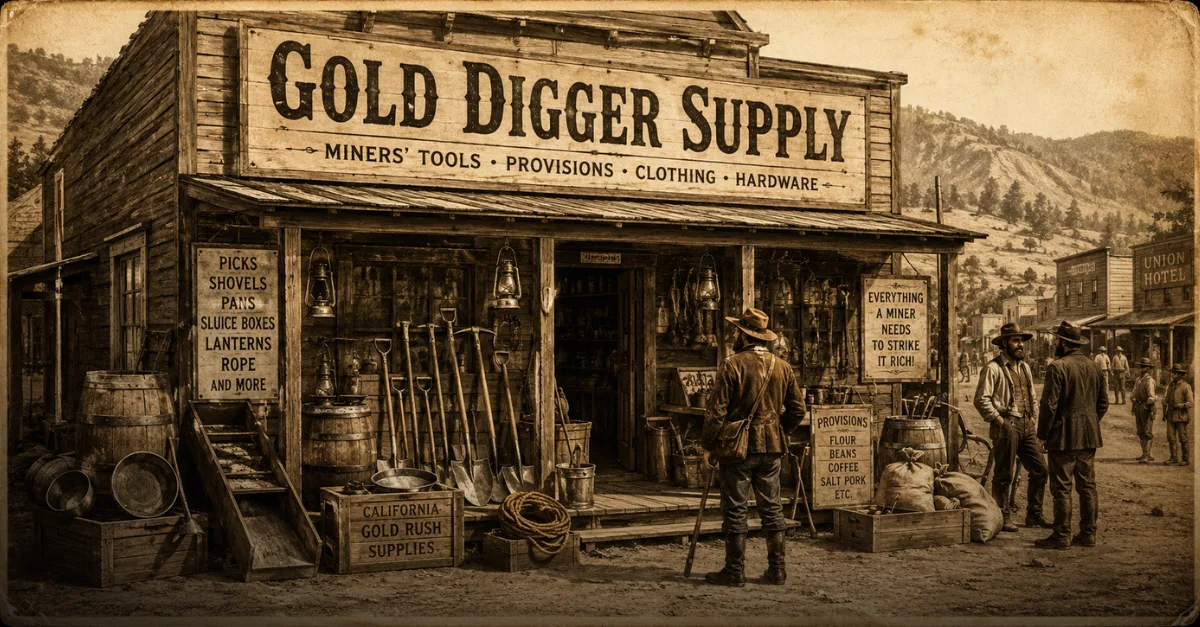
The old Gold Rush analogy is imperfect, but useful. Prospectors took the glamour and the risk. The merchants selling picks, shovels, denim and provisions often earned the steadier money.
AI has its prospectors: model builders, app companies, software platforms, consultants and corporate transformation teams. But the sellers of shovels are becoming harder to ignore. They are the chip designers, foundries, memory suppliers, networking firms, data-centre operators and power providers that turn artificial intelligence from demo into deployment.
Not all will win equally. AMD's position is not Intel's. Intel's challenges are not SanDisk's. SanDisk's recent strength does not erase the cyclicality of memory. A broad thesis is not a substitute for company-specific analysis.
Still, the direction of travel is clear. The scarcity in AI is moving down the stack.
The question boards should ask
Most organisations now have an AI strategy. Some have several. Few lack a slide deck.
The more useful question is whether those strategies are executable under real-world constraints. Does the company know how much compute it will need? Has it assessed whether that compute is reserved, shared or merely assumed? Does it understand its exposure to memory, latency, data movement, cloud pricing and availability? Has it considered what happens if infrastructure becomes more expensive, more politicised or less accessible?
AI may look weightless from the prompt box. Beneath it sits a dense chain of silicon, energy, capital and geography.
The first phase of the boom rewarded those who spotted the model race. The next may reward those who understand the bottlenecks.
In the gold rush of artificial intelligence, the shovels are no longer a metaphor. They are the strategy.