Where to start with AI · First workflow No. 1

Employee questions on HR policy

An internal assistant for HR policy, rolled out in two stages: first it helps the HR team answer, then it answers approved, standard questions on its own.

A first AI use case doesn’t need to be spectacular. It does need to be narrow enough to test, measure, and improve.

Low risk, but only within a strict scope

Questions to HR about vacation, expenses, leave, the employee handbook, or company policies meet all four tests of a good first workflow: they come up often, they have a clear owner, they call for a clear output, and they are a pain point people already feel.

The use case is low-risk only within a strict scope:

The risk does not go away. It becomes more visible, measurable, and manageable once the sources, the scope, and the escalation rules are defined.

A three-step approach

00

Get the policies in order

Identify the documents that apply, resolve contradictions, assign an owner to each document, and date each version. The tool comes after.

01

The assistant drafts, the HR team decides

The assistant drafts a reply that cites the section and its version. An HR team member reviews it, edits it if needed, then sends it. Every correction is logged, topic by topic.

02

The assistant answers on approved topics

It answers when a general, written, current policy applies and the answer can cite its source. It routes to HR any individual, sensitive, or ambiguous situation, and any question whose source is missing, contradictory, or outdated.

Moving from stage 1 to stage 2

The move to stage 2 should not be decided in advance. It depends on what the HR team observes during stage 1: the quality of the drafted answers, the corrections needed, and the system’s ability to recognize situations that fall outside its scope.

Accuracy of the answer and the citationCorrections needed, by topicExceptions correctly routedNo material incident within the tested scopeCurrent sources, each with an owner

Vacation and leave could move to stage 2 while expenses stay in stage 1.

Reference architecture: how the system stays under control

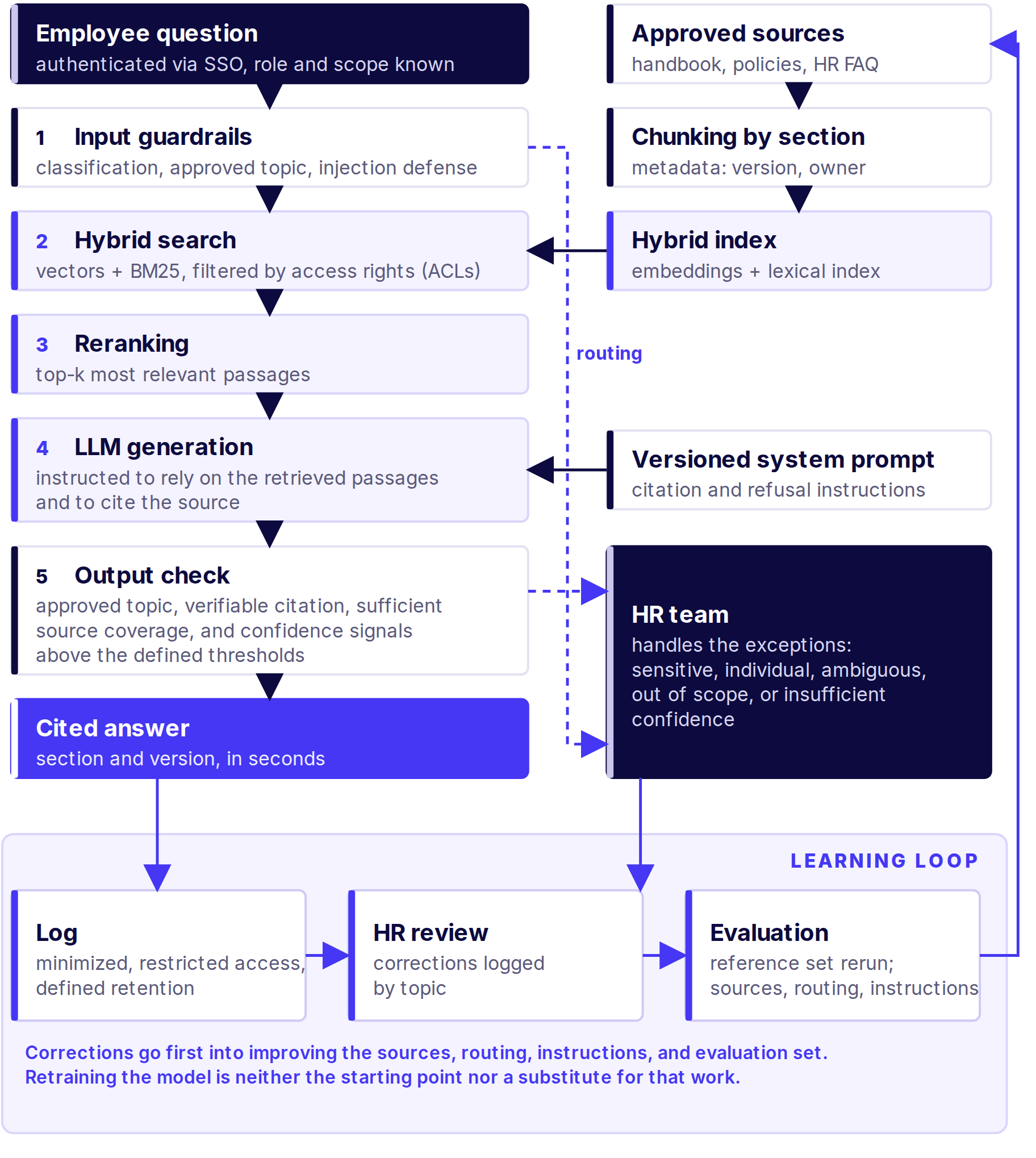
A RAG architecture: hybrid search (vectors + BM25) filtered by access rights, reranking, and generation by an LLM instructed to rely on the retrieved passages and cite its source, with input and output guardrails and routing to HR. A learning loop connects the log, HR review, and the evaluation set.

Diagram: Reference architecture: how the system stays under control

Click the diagram to open it full size.

The controls required before any autonomous answer:

Evaluation. A reference set of about 100 real questions. Metrics: accuracy, faithfulness to sources, correct citation, and the rate at which exceptions are detected and correctly routed. Rerun whenever the model, prompt, or corpus changes.

Observability. Every request is logged: question, retrieved passages, answer, confidence signals, routing decision. Because questions may contain personal data, the log is minimized, accessible only to authorized staff, and kept for a defined period.

Identity and access. SSO (SAML or OIDC). Role-based access control enforced at retrieval, not after generation.

Data. Hosting and data transfers verified for the chosen solution; contractual terms barring use of the data for model training; encryption; log retention and access defined; Swiss FADP compliance verified.

Application security. Protection against prompt injection. The assistant can only answer or route to HR.

Corrections go first into improving the sources, routing, instructions, and evaluation set. Retraining the model is neither the starting point nor a substitute for that work.

The goal

The goal is not to replace an HR decision. It is to cut response times on general-policy questions, stop the same answers from being rewritten, and give HR more time for situations that call for context and judgment.

Illustrative case: fictitious company; all figures are approximate. Sergio Castagna Consulting is a member of the OpenAI Partner Network and a registered partner in the Google Cloud Partner Network. The tool comes after the problem is defined.

The useful question

The question is not “Which tool should we buy?” It is “Which repetitive work can we have AI assist with, measure, and then delegate under clear controls?”

Receive our publications

Choose what interests you.

One email per publication, one-click unsubscribe.

Confirmation by email. Lists hosted in Switzerland by Infomaniak. Privacy